
Conversion or New Build: Two Routes, Two Unknowns
Converting an existing building and starting from bare ground are the two routes into student accommodation or self-storage. Alternative real estate investment opportunities like these are different ways to deploy capital into a property rather than commit to a single development model. Ask which is more attractive on economics alone, and the answer nearly always comes back as a cost per square metre, a construction timeline, or both – both genuine, neither one settling the question it is being asked to answer.
Cost is the least decisive. The clearest published evidence comes from European office conversions rather than student accommodation specifically, but it is the best proxy available and the pattern is unambiguous: costed city by city within a single European Commission study, conversion ranges from roughly 20% cheaper than new build to slightly more expensive. The gap widens further in individual cases: one extreme German comparison puts new build at around two and a half times the cost of conversion. A separate advisory firm, working the same market from the contractor’s side, goes further, stating that, on occasions, extensive retrofits and structural replacements have proven to exceed the cost of new construction outright. Conversion is not reliably the cheaper route. It is the route with the wider range of outcomes.
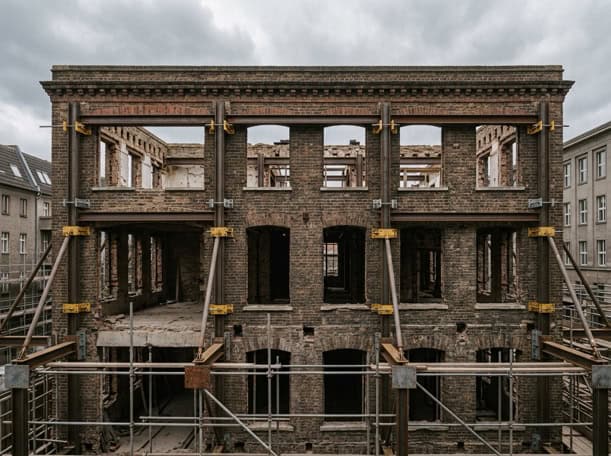
Speed fares better, but only in places. In the same office-conversion evidence, a Brussels conversion is permitted in around 11 months against a typical 2-3 years for new build, and Barcelona shows a similar gap. That still sits outside Italy and outside student accommodation, and a meaningful part of even this advantage is temporary rather than structural: several of the fastest routes exist only because a government legislated a special, time-limited exemption into planning law within the past two years, France among them. When the exemption lapses, so does the speed advantage that came with it.
The embodied-carbon case is the clearest discriminator. It is also, today, the one that earns no premium. Refurbishment accounts for 2-10% of a building’s 60-year lifecycle emissions against 28-31% for demolition and rebuild, and on published academic modelling a new building needs roughly 52 years of superior operational performance to offset the embodied carbon it spent getting built – longer than any institutional hold by an order of magnitude. That calculation only tells half the story as the emissions advantage is front-loaded. A new build has more potential to reach a high energy-efficiency and certification standard without any constraints from the structural grid or floor-to-floor heights that cannot be changed in a retrofit. In essence, new build costs more in carbon to construct and less to operate over the life-cycle whilst conversion is close to the mirror image. None of conversion’s embodied-carbon advantage shows up in value today: continental European research finds a rental premium for certified buildings of around 6%, and draws no distinction between a retrofitted building and a new one. The premium rewards certification, not the route that earned it.
If cost, speed and carbon do not settle the question between them, something else is doing the work.
What Each Route Asks Investors to Consider
New build puts the focus onto duration and process. The planning route is protracted, and that length has a cost before a single unit is let: professional fees, design, survey and consultant costs that can reach €250,000-500,000, spent before the outcome is known, and a team occupied on one scheme for 2-3 years that could otherwise have been assessing the next transaction. Beneath the planning process sits the ground itself: excavation, foundations, and in a protected historic centre, an archaeological review that can extend the programme by a margin no one can forecast in advance. What it buys in return is a free hand: bed count, unit mix and the ratio of net to gross area are all decided on a blank sheet, not fixed by an existing structure. None of the duration and process risk yields to better diligence, however rigorous. It yields to waiting.
Conversion puts the focus onto the building itself. A competent buyer establishes, before exchange, whether the existing floorplate will take the intended use, whether risers and façade can carry the additional services a change of use demands, and what that change of use triggers on acoustic separation, fire strategy, daylight and escape distance. Stock built from the 1930s to the early 1990s adds an asbestos survey to that list as a matter of course. Structural capacity gets tested too: what the frame will bear, and what it will not. Every item on that list is priced and contracted before commitment.
Some of what conversion involves is not a risk to be surveyed away but a fixed feature of the building itself: room count and layout bounded by the existing structural grid, tall ceilings that photograph well but carry a real energy penalty against a purpose-built floor-to-floor height, and mechanical and electrical routing forced around risers never designed for the load a change of use puts on them. Where the building carries a heritage or conservation designation, the facade must be retained as a matter of course, and the permit for that sits outside the ordinary planning application, adding its own cost and time prior to exchange. None of these constraints surfaces late. Each is known before exchange, and none applies to new build.
That is the key division. Almost everything on the conversion list is establishable before exchange: structural capacity, riser and shaft capacity, façade penetration, floorplate geometry, the compliance triggers that follow from the new use. A surveyor can answer nearly all of it before an offer is submitted. Almost nothing on the new-build list works the same way; a planning authority’s timeline is not a question that a surveyor can answer at any price. What remains genuinely unknown in a conversion (a structural issue found only once strip-out begins, or below-ground conditions no pre-exchange survey could have identified) is real, and it is resolved once vacant possession is granted: the building can then be opened up, whatever was hidden is found, dealt with and priced before the asset is ever let. By the time a tenant moves in, that uncertainty belongs to the acquisition history, not to the building they are living in.
Which suggests the comparison is not about the buildings at all.
The Objection, and What It Misses
The objection, in its strongest form: this is a distinction without a difference. Risk is risk. A diligent investor prices both routes on the same basis and takes the better risk-adjusted return, whichever category the risk happens to fall into. Recasting the choice as a question of which uncertainty an investor prefers to carry is, on this view, a way of avoiding the plainer question of which route is cheaper.
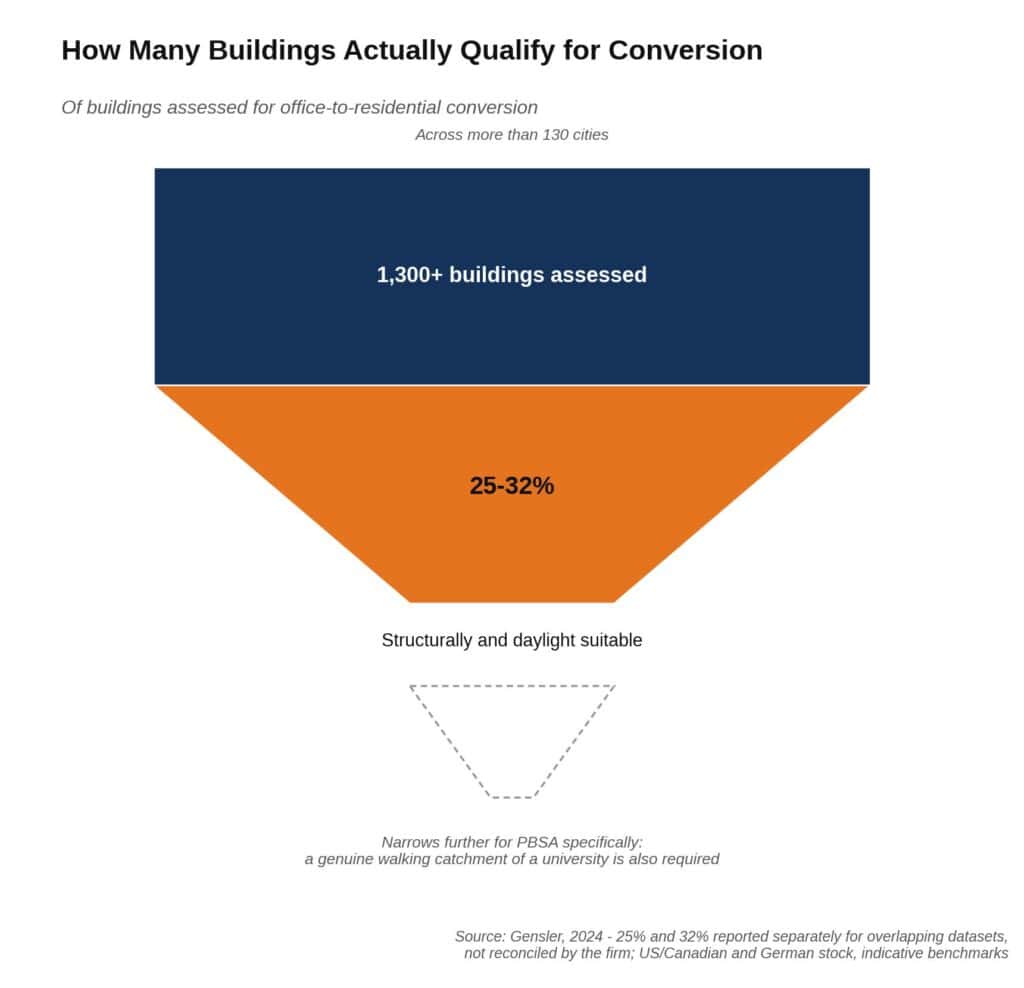
Part of the objection is correct, and worth conceding before it is answered. The choice is only live in a minority of buildings in the first place. Of more than 1,300 buildings assessed across more than 130 cities, roughly a quarter to a third scored as suitable candidates for conversion, and the binding constraint was daylight geometry rather than structure, a limit that cannot be designed around or bought out. For student accommodation specifically, that narrow field narrows again: a qualifying building also has to sit within a genuine walking catchment of a university, which in most European cities means the same handful of dense, historic streets that produced the daylight and structural constraints in the first place. For three buildings in four, there is no comparison to make at all, and the buildings that both pass on suitability and stand in the right place are a minority of that minority. The stock that qualifies is scarce, not merely selective. (US and Canadian stock, treated here as an indicative benchmark.)
The same dense, historic streets that narrow the conversion-suitable pool are also where new-build land is hardest to find: little undeveloped ground, and what exists is priced and permitted for other uses. In most of these locations, conversion is the only practical way in – the choice the objection describes only opens up once the search moves beyond the centre.
Where the choice is genuinely live, the objection still overlooks how that choice is financed. The two routes are not being compared on expected value so much as on the shape of the distribution around it. New-build cost is tightly bound and its programme length is loosely bound; conversion inverts that, a programme length that is short and comparatively predictable against a cost outcome that can, on the evidence above, spread wide enough to exceed new build altogether. Part of that spread is political rather than procedural: a scheme reviving a stranded or derelict building tends to draw local support that eases its passage, while a scheme on open land more often turns on the detail of what is being built. It is the same mechanism as the legislated exemptions described earlier, just exercised locally rather than by statute, and lasts only as long as the goodwill does. The lightest-touch conversions benefit most from that goodwill: an extension (enlarging an existing structure under a light-touch planning consent) asks little of the local authority and little of the neighbours, coming closer than either route usually does to avoiding this category of uncertainty rather than managing it. Two routes that arrive at similar expected outcomes with different variances are not the same instrument to a lender, and they do not clear at the same cost of capital. Nor do they offer a buyer the same shape of exit: a land option can simply lapse for the cost of the option, while a conversion already opened up under vacant possession has no such clean exit – what happens next depends on the skill applied to it, not on the option to walk away. That is a mechanism a term sheet prices, not a preference.
The same division appears in a sector where the variables are inverted.
The Second Proof
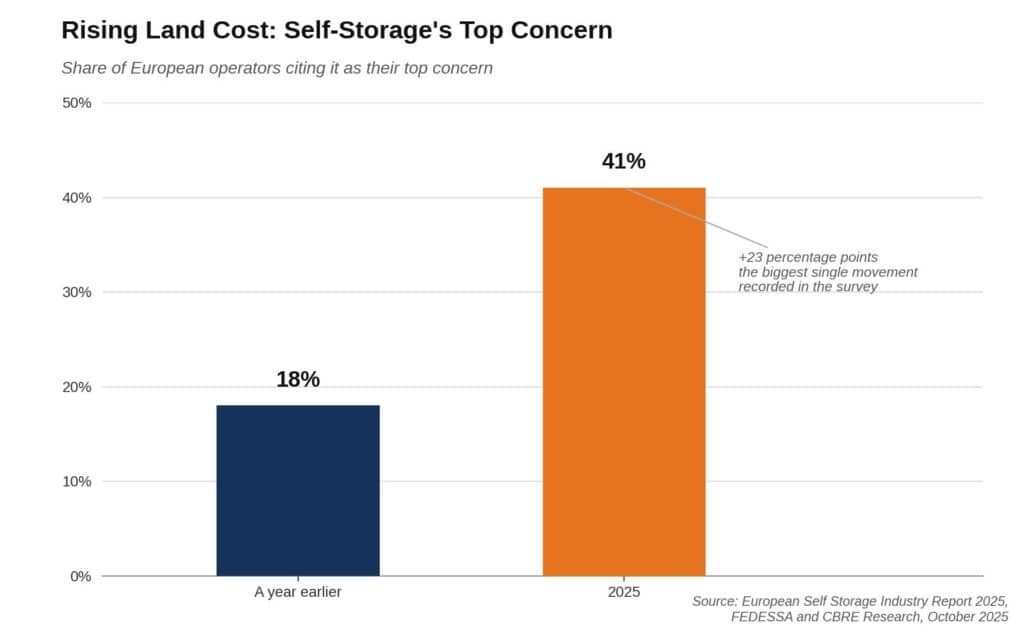
Self-storage investment tests the same argument from a different starting point. The format depends on compact neighbourhood hub sites, typically 1,500-2,000 square metres, and in a developed city centre, land at that scale is effectively unavailable as brownfield or greenfield – conversion is often the only practical way in. European self-storage has grown quickly over the past decade, and growth is now meeting the same constraint at industry level: rising land cost is the largest single concern among European operators, cited by 41%, up 23 percentage points in a year, the biggest single movement recorded in the survey. The sector’s own annual report attributes its slowing growth to operators being unable to locate suitable property at all.
Outside those hub locations, where land is available at ordinary cost, new build is the favoured route. There is no European evidence that converted self-storage assets trade at a wider yield than purpose-built stock, because the sector does not price the route in the first place: a lender underwriting a stabilised store asks about occupancy and rate, not about what the building was before. A stabilised store is valued on its operating performance, not on how it came to exist. What separates the two routes in this sector is not exit pricing but unit mix (the industry’s primary revenue lever), and here the advantage sits with new build: a purpose-built facility sets its grid, clear height and yard geometry to the intended mix from the first drawing, while a converted building’s mix stays bounded by whatever the existing structure allows.
Two sectors, one division: what can be established before commitment, and what cannot.
What the Route Commits You To
Neither route dominates the other on the evidence that exists, and neither is reliably the cheaper choice, though often only one is genuinely on offer, depending on location. Where a real choice exists, the difference that counts is the category of uncertainty each one asks an investor to accept: how much sits on the buyer’s side of exchange, available to diligence, and how much sits beyond it, resolved only by time. That division does more work than the route itself.
A route that front-loads its unknowns into surveyable ground rewards a buyer with the capability to survey the building properly and the discipline to walk away when the survey says no. A route that defers its unknowns to a planning process outside anyone’s control rewards a buyer with the balance sheet to fund the wait and the patience to see it through to a stabilised year. Both are legitimate ways to build an operational real estate portfolio, and both, done well, arrive at the same place: a stabilised asset generating income against the hold that was underwritten. Neither is inherently the better one, and a manager who claims otherwise is selling a preference as if it were a fact.
The question this leaves an allocator is not which route is winning. It is whether the manager they are backing has actually built the specific capability their chosen route demands: the diligence to survey a building properly and walk away when it fails, or the balance sheet and patience to sit through a planning process with no fixed end date. Some firms hold both capabilities, built separately rather than assumed from one another, and strength in one is no guarantee of the other. What should be underwritten is that fit between the manager and the uncertainty they have chosen to take on, not the route itself.