
European Operational Assets From Abroad: Rates, Bonds and the Euro

Reading the Return Figure
Most investors in European real estate judge an asset on one return figure set against a hurdle, and the gap is read as the reward for holding it. For a portfolio manager working to a dollar base currency, that figure is shaped by three forces outside the asset. The rate cycle sets what cash and bonds pay and the cap rate at which an income is sold. The bond comparison asks why an asset should be held when a fixed coupon is available. The euro decides what the return is worth in dollars. Investing in European real estate from overseas changes all three at once. The investor takes on a different interest-rate environment, a different bond market to benchmark against and a different currency. For some investors that difference is the reason to look at international markets in the first place, as a way to diversify beyond their domestic holdings. It is also one reason investors look at alternative real estate investments such as self-storage and student housing.
A single return figure blends the three, so each is better judged on its own. Of the three, only the property income can be worked from inside the asset. In self-storage and student housing the lever is the contract: short, made up of many small rents, and reset far more often than a long lease would allow. That gives operators room to respond to changing market conditions, whichever way they move.
.
Income Is the Term an Operator Can Reset
Self-storage contracts roll monthly, so new customers start at today’s rents and the operator can adjust rents flexibly over time. Student housing tends to be set by the academic year, so rents are generally fixed for each academic-year letting cycle and can be reset when the next cycle opens. In both, the contracts are short and made up of many small rents, each with its own reset date, so income can follow prices in a way that a long lease, fixed for years, cannot.
One example shows the mechanism at work. At a listed operator’s self-storage facilities in Germany, the average rent per let m² rose 30% between 2021 and 2025, against consumer prices up 21% over the same period. The measure is rent per let m² and covers existing customers as well as new lettings. Those customers stay for years, so the contract is short and the effective tenancy long: the short contract allows the reset, and the long effective tenancy is the customer base on which the resets were made, which is driven by life events and the academic year more than by office or retail conditions.
The income also rests on a steadier base of demand. People need storage when they are moving up and when they are scaling down, and students study in good years and bad, so demand for both may depend less on the economic cycle than it might for office or retail space.
What the asset keeps after costs is where operations show: the choice of operator, cost control, the use of technology and the contract structure all influence it, and an investor can test each before committing. The lever has limits: customers can leave, contract terms can tie increases to costs, and a push on rent can cost occupancy, which is why rent is only half the picture and the operator watches both.
Where the Reset Ends and the Sale Price Begins
An investor is paid twice: through income during the hold and through the sale price at the end. The sale price rests on the asset’s generated sustainable income and on its cap rate, meaning the income return a buyer expects on the price paid, which follows the rate cycle. The lever reaches the first and not the second. It is also the bond comparison stated as a mechanism. A bond fixes its income at issue in return for certainty. An operating asset makes the opposite trade: its income follows the market, up or down, in return for the ability to respond.
The cap rate is outside the operator’s hands. When the cap rate rises, the same income is worth less however well it has been managed, and the sale price falls, all else equal.
Patience is part of the answer. A 5-7 year hold is an underwriting assumption, and if values are down as it nears its end, the income can keep being worked while the market recovers. Where financing and fund terms permit, the sale can wait for a better moment on rates, and on the euro for any investor who has left that exposure open.
At the level of capital supply, JPMorgan Asset Management has said that alternatives are one of three priorities driving its European growth, alongside active ETFs and partnerships with wealth managers. The statement covers alternatives in general and does not focus on real estate, so it describes direction and not demand for any asset. PwC projects that European assets under management in alternatives as a whole will reach $7.7tn by 2030 in its base case.
Whatever income the European asset produces and whatever price it achieves, both are denominated in euros.
The Euro Belongs at Portfolio Level
The operating levers act on euro income and have no effect on the exchange rate, so the euro is a separate position, and one that can cut both ways. It is also a question about the investor’s portfolio and not about this one asset. A portfolio manager will rarely hold a single asset, and the euro exposure from this one adds to or offsets whatever else the portfolio holds. Currency is therefore best decided at portfolio level, where a portfolio manager will usually choose to hedge it, so that the asset’s result is largely isolated from currency movements.
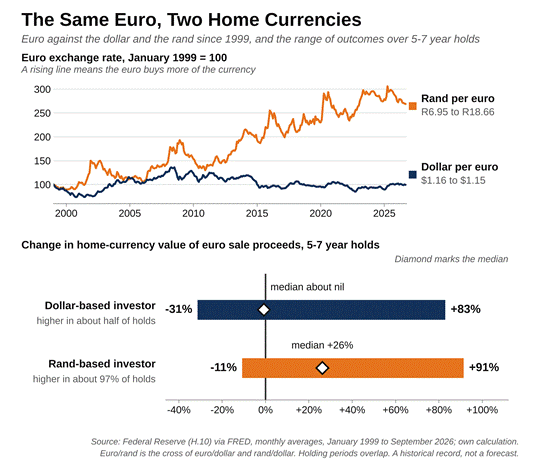
The reason is the range. Monthly averages since 1999, through to September 2026, show that over 5-7 year holding periods the dollar value of euro sale proceeds has moved from a loss of about 31% to a gain of about 83%, with a median near nil. Between a quarter and a third of holding periods ended more than 10% higher, and a similar share ended more than 10% lower. The holding periods overlap, so independent observations are few, and the range records what the euro has done and not what it will do.
Hedging can narrow that range, but rolling shorter-dated hedges does not lock in one conversion rate for the entire hold. Its cost or gain reflects the gap between euro and dollar interest rates, which is compensation for a rate difference and never a return the asset has produced. Over a 5-7 year hold it also has frictions: margin may have to be posted when the euro rises, and neither the income nor the sale proceeds being hedged are known when the hedge is placed. Those are portfolio costs, and they are the price of keeping the currency apart from the asset decision. Whether to hedge, and how much, is the investor’s decision at portfolio level, and the asset does not make it.
The same position reads differently from another home currency. Several Gulf currencies, including the dirham and the riyal, are pegged to the dollar, so a dollar base is the usual starting point for Gulf investors. For an investor whose home currency is the rand, the same test gives another answer: over the same holding periods the euro ended higher against the rand in about 97% of them, with a median gain of about 26% and a worst case of about 11% lower. That records the rand’s past decline against the euro and not a forecast. It is why the same open exposure can be a risk to one investor and the reason for another to look abroad.
The Obvious Challenge
The obvious challenge is that raising rents did not stop values falling. Values did fall with rates: INREV’s index of European unlisted real estate recorded six consecutive quarters of falling values to the end of 2023. The index is an all-sector, appraisal-based proxy for the operational sectors and not a measure of them. On that view the income lever is a small help against a large effect. How large the help is cannot be said, because no published data gives it for self-storage or student housing.
The answer is that the income is the one part of the price with a response inside the asset. When the cap rate rises, value holds only if income rises in the same proportion. The operating levers act on the income.
The claim is deliberately narrow. It asserts no size of offset against rates or the bond comparison. It says that the three forces can be separated, and that each then has its own decision.
What Follows for the Allocation Decision
For a portfolio manager working to a dollar base currency, each variable guides a different decision. The income lever can be influenced by the choice of operator, cost control, the use of technology and contract structure. The sale cap rate guides the timing and horizon of the hold. The currency is a portfolio decision that belongs to the investor alone and may not correlate at all with the other two. The income and the sale cap rate are the same wherever the investor sits, whereas the currency question changes with the investor’s home currency.
The practical questions follow from that. On the income, an allocator can ask an operator how often rent can change, what the contracts allow, how long customers stay, and what happened to occupancy the last time rent was raised. On the sale, the question is how long the hold can run if the market has not recovered. On the currency, the question belongs to the portfolio and not to the asset. The exposures are then identified, each has a decision attached, and a patient investor has room to choose the moment.